This blog has moved to a new address--see you there!
Tuesday, October 18, 2016
Tuesday, September 20, 2016
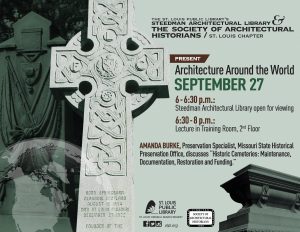
HISTORIC CEMETERIES
Our Fine Arts
Department is thrilled to begin the second half of their lecture series,
"Architecture Around the World", in September. This series is a
partnership between the St. Louis Chapter of the Society of Architectural
Historians and the Steedman Architectural Library of SLPL.
NOTE: Because of the Fantasy Maps exhibit in our Carnegie Room, this talk will be held in the "Training Room", a room that located on the same (second) floor as the Steedman Room and Fine Arts Dept.
First up will be
Amanda Burke of the Missouri State Preservation Office speaking on
"Historic Cemeteries: Maintenance, Documentation, Restoration, and
Funding". It will be held on Tuesday, September 27. The Steedman Room will
be open for viewing starting at 6 p.m.; the talk will begin at 6:30 p.m.

Thursday, September 15, 2016
DPLA PRIMARY SOURCE SETS
While Digital Public Library of America (DPLA) Primary Source Sets are designed to help students
develop critical thinking skills by exploring topics in history, literature,
and culture via primary sources, I think they will prove useful for anyone
beginning to explore a covered topic. Materials are drawn from the online
exhibits of libraries, archives, and museums across the United States, and can
include letters, photographs, posters, oral histories, video clips, sheet music,
and more. Each set includes a topic overview, ten to fifteen primary sources,
links to related resources, and a teaching guide with discussion questions and
classroom activities.
I took a closer look at the U.S. History category. Numerous
topics are included that may interest genealogists, among them:
- Full Steam Ahead: the Steam Engine and Transportation in the 19th Century
- The Great Migration (1910-1930)
- The Homestead Acts
- The Underground Railroad and the Fugitive Slave Act of 1850
- The War of 1812
- The Yellow Fever Epidemic of 1878
- Women in the Civil War
- World War I: America Heads to War
- World War II: Women on the Homefront
Additional Primary Source Sets cover:
- World History
- African Americans
- Asian Americans
- Latino Americans
- Native Americans
- Migration
- Women
Information of this sort can prove very useful as we try to
solve research roadblocks, or flesh out a dry-as-dust family history. Take a
look!
HAPPY DAYS
Ancestry.com includes many data collections of interest to
genealogists. One that is likely to interest many of our genealogists is Happy
Days, the official newspaper of the Civilian Conservation Corps (CCC) camps.
The CCC was created by Congress in 1933. It provided jobs
for unemployed, single men (most 17-25 years of age). These men worked on
conservation projects like road and trail building, tree and shrub planting,
erosion control, and also responded to natural disasters like floods and forest
fires. By time the program ended in 1942, the CCC had established work camps in
every state, and provided employment for 3 million young American men (and 8,500 young American women, who toiled in camps known by their slang name, "She-She-She" camps).
![]() |
| Sign for CCC companies in the Badlands |
Happy Days was a privately owned newspaper that was
available for purchase in CCC camps, or could be mailed to the folks back home.
It cost 3 cents per week if purchased in a camp exchange, 5 cents per week if
mailed back home. This Ancestry.com record set includes weekly issues from 1933
through 1940. It is browsable only (not indexed at this time).
Happy Days was intended to serve as a source of information
and entertainment for CCC enrollees. Each issue included articles on camp work
projects and accomplishments, camp leisure activities like sports, involvement
of CCC enrollees in disaster relief, and hanges in the CCC administration and
higher-level personnel. Each issue also included editorials and a few
advertisements.
Monday, September 12, 2016
COLLAGE OF CAPE COUNTY
Our genealogy collection concentrates on the State of
Missouri, and states and countries that furnished large numbers of migrants to
Missouri. As part of that research focus, we collect printed genealogical
materials for various Missouri counties, including family histories, record
compilations, county and local histories, and publications of county genealogical
and historical societies.
One newsletter we receive is Collage of Cape County (Cape
Girardeau County Genealogical Society). This quarterly newsletter originates
from the society’s headquarters in Jackson, Missouri. Newsletters are sixteen
pages long (fifteen pages of content and one page for mailing info). Contents
generally consist of family stories, transcriptions of county records, plus a
list of recent society acquisitions and an index for the issue at hand.
Issues of this newsletter for 2011-present are available in
the Genealogy Room. Our collection also includes several Cape Girardeau County
histories and record compilations, which you can locate by searching our
Catalog for these terms (case does not matter):
cape girardeau county missouri genealogy
cape girardeau county missouri history
You can find more info about this society, its events and publications here.
CCHS MUSEUM NEWSLETTER
Our genealogy collection concentrates on the State of
Missouri, and states and countries that furnished large numbers of migrants to
Missouri. As part of that research focus, we collect printed genealogical
materials for various Missouri counties, including family histories, record
compilations, county and local histories, and publications of county historical
and genealogical societies.
One newsletter we receive is CCHS Museum Newsletter (Chariton
County Historical Society). This quarterly newsletter originates from the society’s
museum in Salisbury, Missouri. Newsletters are ten pages long (nine pages of
content and one page for mailing info). Contents generally consist of
transcriptions of newspaper articles, short articles about Chariton County
history, plus a list of society acquisitions and pubications.
Issues of the newsletter for 2012-present are available in
the Genealogy Room. Our collection also includes several Chariton County
histories and record compilations, which you can locate by searching our
Catalog for these terms (case does not matter):
chariton county missouri genealogy
chariton county missouri history
You can find more info about this society, its events and publications here.
AUDRAIN COUNTY AREA GENEALOGICAL SOCIETY NEWSLETTER
Our genealogy collection concentrates on the State of
Missouri, and states and countries that furnished large numbers of migrants to
Missouri. As part of that research focus, we collect printed genealogical
materials for various Missouri counties, including family histories, record
compilations, county and local histories, and publications of county historical
and genealogical societies.
One newsletter we receive is Audrain County Area Genealogical
Society Newsletter. This quarterly newsletter originates from society
headquarters in Mexico, Missouri. Newsletters are eight pages long (seven pages
of content and one page for mailing info). Contents generally consist of
material reprinted from local newspapers, but can also include queries plus
info about society meetings, events, officers, new members, and deaths of
long-time members.
Issues of the newsletter for 2007-present are available in
the Genealogy Room. Our collection also includes several Audrain County
histories and record compilations, which you can locate by searching our
Catalog for these terms (case does not matter):
audrain county missouri genealogy
audrain county missouri history
You can find more info about this society, its events and publications here.
Thursday, September 1, 2016
FREE GENEALOGY CONFERENCE!
That's right, folks--this upcoming conference is free (including lunch!). They would not refuse a generous donation from you, but that will be a matter for you and your conscience to sort out. Now, I am one of the presenters, so of course this will be a quality affair...
ANCESTRY.COM FREE WEEKEND
Access to occupation records on Ancestry.com will be free now
until September 5, 2016 at 11:59 p.m. ET (they do require registration for a
free temporary Ancestry account). After the free access period ends, you will
only be able to view the occupation records using an Ancestry paid membership.
You may view a full list of occupation records via the search page (they’re
including federal and state censuses in the list!).
Tuesday, August 30, 2016
ANCESTRY.COM SPOTLIGHT: U.S. NAVY SUPPORT BOOKS, 1901-1902, 1917-2010
Navy support books are "yearbooks" for naval units
based on land rather than onboard ship. For example, this collection includes
books for the U.S. Navy Preparatory School, Navy ROTC programs at various
colleges and universities, U.S. Naval Officer Candidate School, U.S. Naval
Training Centers, U.S. Merchant Marine Academy, mobile construction battalions,
recruiting depots, naval air stations, and others.
Content of support books varies. Some contain labeled individual
head shots or group photos of unit members, while others contain only candid (unlabeled)
photographs of unit members at work and play. Some contain photos documenting
significant events in the history of that naval unit, and most include short
biographies of prominent currently-serving officers. Photos are sometimes
color, sometimes black and white (sometimes both types in one support book). A
majority of these books date from World War II era forward.
It is possible to search or browse these books. The
following searches are possible:
- First & Middle Name
- Last Name
- Keyword
- Year (covered by Support Book)
- School, Station, or Unit
You can also browse by:
- Location (state or territory)
- City
- Year (covered by Support Book)
I browsed through a Support Book for the Parris Island
Recruit Depot (South Carolina), 1973. This 128 page item includes a photo and
bio sketch of the commanding officer, an historical sketch of Parris Island,
and a photo essay (in color) concerning the training of Marine Second Battalion, Platoon 226. This unit began training on 19 March 1973, and
graduated on 5 June 1973. The photo essay begins with the arrival of these
recruits at Parris Island, and ends with their graduation ceremony. These photos
are not labeled, but are generally sharp and clear, so that it would be fairly
easy to identify recruits of interest. Next are labeled black and white head
shots of training officers and enlisted men, followed by labeled head shots of graduating
recruits.
Labels:
Ancestry.com,
Military history,
U.S. Marine Corps,
U.S. Navy
ANCESTRY.COM SPOTLIGHT: U.S. Navy Cruise Books, 1918-2009
This data collection within Ancestry.com contains U.S. Navy
cruise books for various ships and years from 1919 to 2009. It includes volumes
in the Navy Department Library, which owns the nation’s largest collection of
cruise books. You can locate this collection by searching in Ancestry’s Card
Catalog using Navy in Title or Keyword.
Cruise books are similar in some ways to high school
yearbooks. They are put together by volunteers on board ship to commemorate a particular
deployment. They generally include a history of the vessel in question, plus
labeled portraits of high-ranking officers. There is generally a biographical
sketch of the current commanding officer. Some cruise books also include portraits
of sailors and other personnel aboard the ship, accompanied by the individual’s
surname and naval rate. When provided, portraits are generally organized
alphabetically by surname within each division or department. Other features
usually include candid photographs (often not labeled) of crew members at work
and recreation.
I browsed through a cruise book for the U.S.S. Missouri (BB
63, 1946). It included a section on the commissioning of the vessel, a history
of its cruise, and a special section on the acceptance of the Japanese
surrender on the vessel, which was anchored at the time in Tokyo Bay. There is
also a section on President Truman’s visit to the U.S.S. Missouri while it was
anchored in New York Harbor after its return from the Pacific.
Cruise books are not official Navy publications, so the Navy
does not sell or republish these books. This can make copies of some cruise books,
especially older volumes, rare and difficult to locate.
This collection is searchable by ship name, ship ID, year,
and name of crew member.
Given that photographs are often unlabeled, it may be
necessary to page through cruise books for vessels on which a sailor was
stationed should an index search prove unsuccessful. You can sometimes discover
which vessels a WWII-era sailor was stationed on using a separate Ancestry.com
data collection, U.S. World War II Navy Muster Rolls, 1938-1949.
Friday, August 26, 2016
YOUR GENEALOGY TODAY (JUL/AUG 2016)
Your Genealogy Today 2:3 (Jul/Aug 2016) includes a number of
articles of likely interest to our genealogists.
Picture This! (p. 13) discusses use of photos on blogs,
websites, and in printed publications. The short answer to “Can I use this
photo?” is it all depends…
Breaking through Brick Walls with Bricklayers’ Union Records
(pp. 14-20) discusses resources available for persons researching bricklayer
ancestors in the U.S. and Canada.
America Discovers America: the Federal Writers’ Project
(pp.24-26) looks this 1930s work relief program that employed thousands of
writers, editors, historians, and researchers, and produced more than 1,200
publications.
Finding the Reeds (pp. 31-35) shows how census records can
be used to help track the movements of a family that rarely stayed in one place
for very long.
How to Approach Family History Research Like an Historian
(pp. 38-39) demonstrates how genealogists can employ techniques similar to
those utilized by professional historians in order to create more engaging and
better-documented family histories.
INTERNET GENEALOGY (AUG/SEPT 2016)
Internet Genealogy 11:3 (Aug/Sept 2016) includes a number of
articles of likely interest to our genealogists.
Researching Northern Ireland (pp. 7-11) outlines the steps
and sources that helped one researcher trace his McGinn family ancestors.
Tippling and Temperance in the Family (pp. 13-16) looks at
records associated with alcohol and the temperance movement that researchers
may find useful when taking a closer look at the lives of certain ancestors.
The International Classification of Diseases: a Key for
Deciphering Death Certificates (pp. 18-21) looks at this system of medical
coding that can sometimes assist the researcher in determining cause of death.
A First Look at rootstrust (pp. 22-26) is a review of a new
desktop genealogy application that works cross-platform, i.e., with all major
operating systems.
Create Your Own Online Family Archive (pp.47-49)
demonstrates how genealogists can use Omeka.net to upload, organize, and share
video and audio files, images, and information with others on the web. A basic
personal account is free, although users can choose pay options that provide
additional themes, storage, and programmatic options.
INTERNET GENEALOGY (JUN/JUL 2016)
Internet Genealogy 11:2 (Jun/Jul 2016) includes a number of
articles of likely interest to our genealogists.
Free UK Genealogy (pp. 12-13) looks at three valuable free
websites that offer lots of information, including indexes of births,
marriages, and deaths, historic parish registers, and 19th century English and
Welsh censuses.
Tell Their Stories! (pp. 14-16) discusses how
FamilySearch.org is helping researchers to preserve and share the stories of
their ancestors’ lives.
Online Genealogy Sources for Researching the Great
Depression (pp. 18-21) enumerates some easily accessible records that can help
you flesh out the lives of Depression-era (1929-1941) American ancestors. For
example:
- 1930 U.S. Census
- 1940 U.S. Census
- State census (1935 available for a few states)
- School census (exist for a few states)
- City directories and telephone books
- Civilian Conservation Corps records
- Farm Security Administration photos
- Office of War Information photos
- Historic American Buildings Survey
- Federal Writers Project
- State Emergency Relief Program database (OK)
- Old Age Pension database (ID)
The author provides a description of and URL for each of
these potential genealogical gold mines.
Supreme Court Cases and Your Family History (pp. 42-44)
looks at legal reference materials that may offer research results of great
interest to family historians.
FAMILY TREE MAGAZINE (JUL/AUG 2016)
Family Tree Magazine 17:4 (Jul/Aug 2016) includes a number of articles of likely interest to our genealogists.
The End of the Paper Trail (pp. 21-26) provides 12
strategies for reducing your paper clutter and sharpening your genealogical
focus.
Getting There from Here (pp. 27-32) shows you how to
efficiently tackle research problems by determining your destination and
mapping out a route to get there.
Workbook: Local Histories (pp. 33-42) demonstrates how to
locate and make the most of county and local histories in your family research
endeavors.
Ancestry Boutique (pp. 42-47) looks beyond the big
collections on Ancestry.com (like census records and the public trees) to
highlight nine lesser-known “specialty” databases. Included are tips on using
the Card Catalog, and tips on doing effective keyword searches.
On the Right Track (pp. 54-61) provides research tips and
useful websites for tracking down elusive South American ancestors.
Genealogical vs. Genetic Family Trees (pp. 62-63) explains
the differences between these types of trees, and dispels some of the more
common misconceptions about genetic trees.
Export Your Tree from Family Tree Maker (pp. 70-71)
demonstrates step-by-step how to export a family tree file from Family Tree
Maker 2012 or Family Tree Maker 2014.
AMERICAN SPIRIT (JULY/AUGUST 2016)
American Spirit 150:4 (Jul/Aug 2016) includes a number of
articles of likely interest to our genealogists.
Photosharing Etiquette (p. 10) provides five guidelines for
sharing images on the web.
The Regulation Movement (pp. 26-30) details conflicts in
colonial North Carolina between farmers and corrupt local officials over
British laws, policies, and taxes. The conflicts took the form of petitions for
reform, disruption of local courts, and even an honest-to-goodness battle
(1771).
Playing in the Colonies (pp. 32-35) looks at toys and games
colonial-era children used to amuse themselves.
Marylanders at the Battle of Hobkirk’s Hill (pp. 41-48)
discusses a little-known battle in South Carolina that pitted colonial patriots
against Loyalists and British regulars. The author believes that the battle
deserves wider recognition since it helped set the stage for eventual Patriot
victory in that state.
Wednesday, August 10, 2016
Tuesday, August 9, 2016
THE CIVIL WAR ONLINE
The following magazine articles are available online to our
cardholders in the History Reference Center database.
5 REBELLIOUS LONG ARMS. Civil War Times (August 2016) Vol.
55, Issue 4.
Southern arms manufacturers turned out thousands of
serviceable, reliable muzzle-loading muskets to issue to Rebel troops,
including the five discussed in this article.
TEMPEST AT COOL SPRING. Civil War Times (August 2016) Vol.
55, Issue 4.
Union pursuers caught up with Confederate soldiers under
Jubal Early’s command along the Shenandoah River in July 1864. A bloody contest ensued.
THE SOUTH'S ACHILLES HEEL. Civil War Times (October 2016)
Vol. 55, Issue 5.
How did the South’s agricultural strength become a
devastating weakness? R. Douglas Hurt, head of the History Department at Purdue
University in West Lafayette, Indiana, tackled that question in his 2015 book
Agriculture and the Confederacy: Policy, Productivity, and Power in the Civil
War South (UNC Press). His research is the first comprehensive look at the
topic since 1965. A Civil War Times staffer interviews Hurt in this article.
THE DARK TURN. Civil War Times (October 2016) Vol. 55, Issue
5.
It has become fashionable among scholars to emphasize the
"dark side" of the Civil War. Troubled by what they consider a
literature gone stale with sanitized questions and topics, these historians
seek to revitalize the field by examining the conflict's often disturbing
underside. The “overlooked” war, they note, featured brutality, atrocities,
cowardice, vicious guerrilla activity, and physical and psychological wounds
that left many veterans profoundly damaged.
Saturday, August 6, 2016
Subscribe to:
Posts (Atom)